

About
Institution
1 THE SCIENCE OF LEARNING
What if students were taught not only what to learn, but how to think?
Many students struggle not because they lack intelligence, but because they have never been shown how learning actually works. CognitionLab bridges that gap—combining research on learning with the timeless intellectual practices of reflection, careful reading, and structured inquiry.
Fields such as Educational Psychology and Cognitive Psychology show that successful learners regularly pause to reflect on what they understand, what they do not yet understand, and how they might improve their approach. CognitionLab translates and incorporates these ideas into practical strategies students can apply in everyday study. Learning becomes far more powerful when students move beyond memorization and begin to engage ideas with attention, patience, and curiosity
2 HISTORICAL PREMISES
Learning as the Formation of the Mind
For centuries, scholars believed that education should cultivate the mind as well as the character. Early universities developed traditions of reading closely, debating ideas carefully, and writing thoughtfully. Those traditions still matter.
CognitionLab draws inspiration from both modern learning science and older intellectual traditions that value reflection, humility before knowledge, and a sincere pursuit of truth. Through close reading of texts by Augustine and Aquinas, we understand that learning is a disciplined and practiced process. From Kierkegaard, we understand that learning is not an abstract concept but is rooted in lived experience. Christine de Pizan teaches us that knowledge is gained through ethical habits, that a disciplined mind cultivates sound judgement and the capacity reason, and that education allows us to navigate an ever-changing world. The goal is not simply academic success, but the formation of clear, disciplined, and thoughtful minds.
Although modern education has reframed educational approaches and theories, a fundamental principle remains – understanding develops through the sustained practice of thoughtful inquiry. CognitionLab seeks to revive this spirit of reflective learning by combining contemporary research on cognition with practices that have long supported intellectual growth.
The central continuity across these positions is not doctrinal but methodological: knowledge is never static; it is continually examined, refined, and adapted.
3 PRINCIPLES AND STRUCTURE
One of the most important discoveries in modern learning science is that students learn more effectively when they become aware of their own thinking processes. As such, metacognitive awareness involves the ongoing capacity to observe and evaluate one’s own thinking processes, including the identification of uncertainty, the examination of assumptions, and the adjustment of interpretive strategies in response to error or ambiguity.
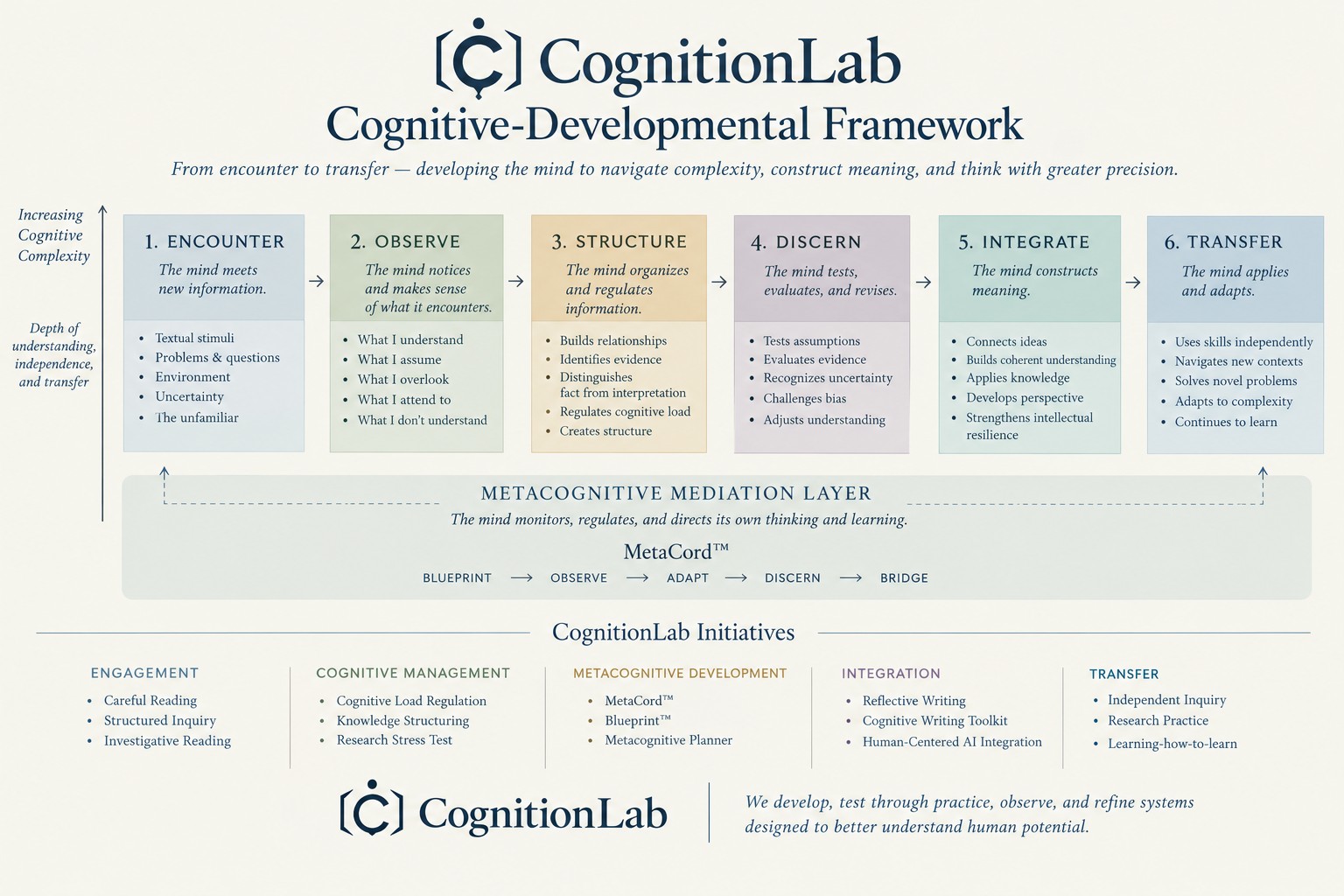
CognitionLab emphasizes four core intellectual practices—reflective reading, analytical writing, intellectual questioning, and metacognitive reflection—that support deeper understanding by engaging structure, clarifying thought, testing assumptions, and evaluating and adjusting one’s approach to learning.
STRUCTURAL FRAMEWORK
CognitionLab is organized around three established interdependent domains—knowledge structuring, cognitive load regulation, and metacognitive development—that function not as content categories but as design constraints for learning systems.
4 ABOUT the CREATOR of COGNITIONLAB
Nicolette C. Nance is an educator, writer, and doctoral student whose work focuses on helping students develop reflective learning practices and strong analytical writing skills.
She is an Adjunct English Professor at Oklahoma Christian University, where she teaches courses including Composition I, Composition II, Creative Writing, and Metacognitive Learning Strategies. She has also taught English courses at Rose State College and Oklahoma State University–Oklahoma City.
In the classroom, Nicolette emphasizes:
- critical thinking
- reflective learning
- analytical reading
- writing as a tool for discovering ideas
Nicolette is currently pursuing a PhD in Instructional Design and Technology at Liberty University, where her research focuses on how learning environments and emerging technologies can better support meaningful learning. She holds an MFA in Creative Writing from George Mason University and a BA in English from Mississippi University for Women.
In addition to her teaching career, she has worked in the publishing industry as an Assistant Editor and Bookkeeper for Relegation Books LLC, supporting authors and helping manage the editorial and administrative processes of the press.
She is also a novelist currently developing her first full-length manuscript.
5 TO CONTACT COGNITIONLAB
CognitionLab maintains correspondence for institutional inquiry, research dialogue, and structured communication related to instructional systems and cognitive design.
Email: connect@cognition-lab.org
Responses are guided by relevance to ongoing work in cognition, instruction, and system design.
6 USE NOTE
CognitionLab is not a content distribution platform and does not function as a commercial publishing service. It is an evolving system of inquiry. All outputs should be understood as working models, not finalized instructional products.
TERMS OF USE
CognitionLab Terms of Use
Effective Date: September 25, 2026
By accessing or using this website, you agree to the following terms.
- Nature of the Site
CognitionLab is an evolving educational and research-based initiative focused on cognition, learning theory, and instructional design.
All materials are provided as conceptual and instructional models intended for educational and intellectual engagement. They are not certified instructional services, academic guarantees, or professional consulting outcomes.
- Provisional Content
All content—including frameworks, models, terminology, written materials, and downloadable resources—should be understood as provisional intellectual models rather than finalized instructional products.
Content may be updated, revised, or replaced at any time as the system evolves.
No content should be interpreted as permanent, definitive, or universally applicable instruction.
- Intellectual Property Rights
All content on CognitionLab, including but not limited to frameworks, text, structures, models, visuals, terminology, and systems, is the exclusive intellectual property of CognitionLab unless otherwise stated.
No ownership rights are transferred through access, purchase, or use.
All rights are reserved.
- License Grant (Limited Use)
Users are granted a limited, non-exclusive, non-transferable, revocable license to access CognitionLab materials for personal, educational, or non-commercial use only.
This license permits:
- Personal study and reading
- Academic reference with attribution
- Classroom use by individual educators (non-commercial distribution only)
This license does NOT permit:
- Commercial use or resale
- Redistribution of full materials in any format
- Uploading content to public or private platforms (including course sites, repositories, or AI datasets)
- Creation of derivative commercial products based on CognitionLab systems
- Prohibited Uses
Users may not:
- Claim CognitionLab content as their own original work
- Reproduce, republish, or redistribute full or substantial portions of content
- Sell, license, or monetize CognitionLab materials without written permission
- Use content to train artificial intelligence systems or machine learning models
- Scrape, harvest, or bulk download site content
- Modify and repackage CognitionLab frameworks for commercial or institutional distribution without authorization
Violation of these terms may result in immediate termination of access and potential legal action.
- Purchasing and Digital Access (If Applicable)
Certain CognitionLab materials, including but not limited to digital guides, instructional frameworks, downloadable resources, or learning modules, may be offered for purchase.
By purchasing any CognitionLab product or resource, you agree that:
- All purchases grant a non-transferable, personal-use license only
- Products are intended strictly for educational and informational use
- Purchase does not transfer intellectual property ownership
- Access may be modified, updated, or discontinued at any time
CognitionLab reserves the right to refuse service or revoke access in cases of misuse or violation of these terms.
- Refund Policy
Due to the nature of digital and intellectual products:
- All sales are generally final upon purchase
- Refunds may be granted only in limited circumstances, including:
- Duplicate charges
- Verified technical failure preventing access
- Documented accidental purchase (within a reasonable time period)
Refund requests must be sent to: connect@cognition-lab.org.
All refund decisions are made at the sole discretion of CognitionLab.
Chargebacks or payment disputes initiated outside this process may result in account termination and access restriction.
- No Academic or Professional Guarantee
CognitionLab does not guarantee:
- Academic outcomes or grade improvement
- Learning performance results
- Institutional accreditation or certification
- Professional certification or employment outcomes
All materials are intended as conceptual learning supports, not formal instruction or credentialing services.
- External Links and Third-Party Content
CognitionLab may reference external sources or materials.
CognitionLab is not responsible for:
- Third-party content accuracy
- Availability of external websites
- Changes to external materials
Use of third-party resources is at the user’s own discretion and risk.
- Limitation of Liability
To the maximum extent permitted by law, CognitionLab and its operators shall not be liable for any direct, indirect, incidental, consequential, or special damages arising from:
- Use or misuse of materials
- Inability to access content
- Reliance on conceptual or instructional frameworks
- Errors, omissions, or updates in content
All materials are provided “as is” without warranties of any kind, express or implied.
- Modifications
CognitionLab reserves the right to update or modify these Terms of Use at any time without prior notice.
Continued use of the site constitutes acceptance of any revisions.
- Contact
For questions regarding these terms: connect@cognition-lab.org.
Copyright & Intellectual Property Enforcement
CognitionLab
Effective Date: September 25, 2026
All content on CognitionLab is protected intellectual property. This includes, but is not limited to: written materials, frameworks, models, terminology, learning systems, instructional structures, and conceptual designs.
- Ownership of Content
All CognitionLab materials are the exclusive property of CognitionLab and its creator unless explicitly stated otherwise.
This includes:
- Learning frameworks and system architectures
- Instructional models and methodologies
- Written content, essays, and research materials
- Terminology, naming systems, and conceptual structures
- Visual or diagrammatic representations
- Downloadable resources and digital materials
All rights are reserved.
No transfer of ownership occurs through access, reading, download, or purchase.
- Protected Nature of Frameworks
CognitionLab frameworks and systems are protected as original intellectual works, including their:
- Structure
- Sequencing
- Methodology
- Conceptual organization
- Pedagogical design
Even partial reproduction, adaptation, or reconfiguration of these systems for external use is prohibited without written authorization.
- Permitted Use (Limited License)
Users may:
- View and study content for personal or educational purposes
- Reference short excerpts with proper attribution
- Use ideas for non-commercial academic discussion
This permission does not extend to reproduction of structured systems or frameworks.
- Prohibited Uses
Without explicit written permission, users may NOT:
- Copy, reproduce, or republish CognitionLab materials in full or in part
- Repackage frameworks as educational systems, courses, or products
- Sell, license, or monetize any CognitionLab content or derivative works
- Upload materials to public repositories, platforms, or shared drives
- Use CognitionLab content in training datasets for AI or machine learning systems
- Present CognitionLab frameworks as original work
- Create derivative instructional systems based on CognitionLab architecture
This includes commercial, institutional, and educational redistribution.
- Derivative Work Restrictions
Any adaptation, modification, translation, restructuring, or reformatting of CognitionLab materials that retains identifiable conceptual structure is considered a derivative work.
Derivative works are not permitted without prior written consent.
This applies even when:
- wording is changed
- structure is partially altered
- content is re-sequenced or summarized
- Enforcement
CognitionLab actively protects its intellectual property.
Unauthorized use may result in:
- Formal takedown requests (DMCA or equivalent)
- Revocation of access to digital products or platforms
- Legal action for intellectual property infringement
- Financial claims for damages or unauthorized commercial use
CognitionLab reserves the right to pursue enforcement in any jurisdiction where infringement occurs.
- AI & Data Usage Restriction
No content from CognitionLab may be used for:
- Training artificial intelligence systems
- Machine learning datasets
- Model fine-tuning or embeddings
- Automated content generation systems
- Knowledge base ingestion without permission
This restriction applies to both public and private systems.
- Attribution
Limited citation of CognitionLab materials is permitted only when:
- Proper credit is given
- Content is not reproduced in full
- The use is non-commercial and academic in nature
Example attribution: CognitionLab (www.cognition-lab.org)
- Reporting Violations
If you believe CognitionLab content has been used without authorization, please report it to: connect@cognition-lab.org.
Include relevant links or documentation when possible.
- Reservation of Rights
CognitionLab reserves all rights not expressly granted in this document.
No implied rights are granted under this policy.